
How to Trigger Events from Calendars & Call Bookings
Recommended: Calendly Integration
If you have a paid Calendly account you can use our Calendly integration to
Use this guide to track calendar bookings from tools like Calendly, Cal.com, and TidyCal, as well as form submissions from Typeform that redirect to your domain. URL Triggers work when the booking flow ends on a confirmation page on your domain. Redirects to external domains cannot be tracked with PixelFlow except for Calendly using our Calendly integration.
Call bookings are one of the most valuable conversion events to track for your Facebook ads. Whether you're generating leads, scheduling consultations, or booking discovery calls, properly tracking these events helps Meta optimize your campaigns to find more qualified prospects.
Understanding calendar booking tracking methods
There are 2 primary ways calendar platforms can handle bookings:
Redirect to your own domain (e.g., yourwebsite.com/thank-you) - ✅ Can be tracked using URL triggers
Redirect to external platform (e.g., calendly.com/confirmation) - 🟨 Can be tracked if you have a paid Calendly and use our Calendly integration
Critical limitation: PixelFlow can only track events that occur on your own domain. If your calendar platform redirects users to an external confirmation page, PixelFlow cannot fire an event because the PixelFlow script only runs on your website (except for Calendly integration)
When URL Trigger tracking works for calendar bookings
URL Trigger tracking is appropriate for calendar bookings only when your booking platform redirects users to a dedicated page on your own domain after they complete their booking.
The success page method
If your calendar booking workflow looks like this:
User views your calendar on yourwebsite.com/book-a-call
User selects a time and completes the booking
User is redirected to yourwebsite.com/booking-confirmed
In this scenario, you can use URL Trigger tracking because the confirmation page is on your domain where PixelFlow is installed.
When this works: URL Trigger tracking is accurate for calendar bookings when the platform redirects to a unique success page on your own domain that users can only reach after completing a booking.
Important: If users bookmark the confirmation page, share the link, or refresh it, you'll track duplicate events. Consider using Event Blocking Rules to prevent duplicates from page refreshes and returning visitors.
Why external platform redirects don't work
Many calendar platforms redirect users to their own confirmation pages after booking:
Calendly redirects to calendly.com/confirmation_page
TidyCal may redirect to tidycal.com/success
Cal.com may redirect to cal.com/booking-success
Other booking tools use their own domains for confirmation
When a user lands on these external pages, the PixelFlow script is not present because it's only installed on your website. Without the script, no event can be fired to Meta.
Technical explanation: PixelFlow works by adding a tracking script to your website's pages. This script can only execute on pages where it's installed. When users navigate to a different domain, your script doesn't run on that external site.
Solution: Configure custom redirect URLs
Most calendar platforms offer the ability to redirect users to a custom URL after booking. This feature allows you to send users back to a page on your own domain, where PixelFlow can track the conversion.
Platform requirements: Calendly requires a paid subscription to enable custom redirect URLs. TidyCal offers this feature for a one-time fee of $29. Cal.com offers custom redirect URLs on all plans.
Set up calendar booking tracking with URL Triggers
Step 1: Create a confirmation page on your domain
Create a new page on your website with a unique URL that users will only see after booking a call. Examples:
yourwebsite.com/booking-confirmed
yourwebsite.com/thank-you-for-booking
yourwebsite.com/call-scheduled
This page should:
Thank the user for booking
Provide next steps or what to expect
Include any relevant booking details or preparation instructions
Pro tip: Make this URL unique and not easily guessable. Avoid generic URLs like /thank-you that might be used for other conversions.
Step 2: Embed your calendar on your website
When you set up your calendar in Calendly, Cal.com, TidyCal, or your booking platform, you'll receive an embed code. Add this code to the page on your website where you want visitors to book calls.
<!-- Calendar embed code example -->
<div class="calendly-inline-widget" data-url="https://calendly.com/your-link"></div>
<script src="https://assets.calendly.com/assets/external/widget.js"></script>
Place this code on your website page where you want the booking calendar to appear.
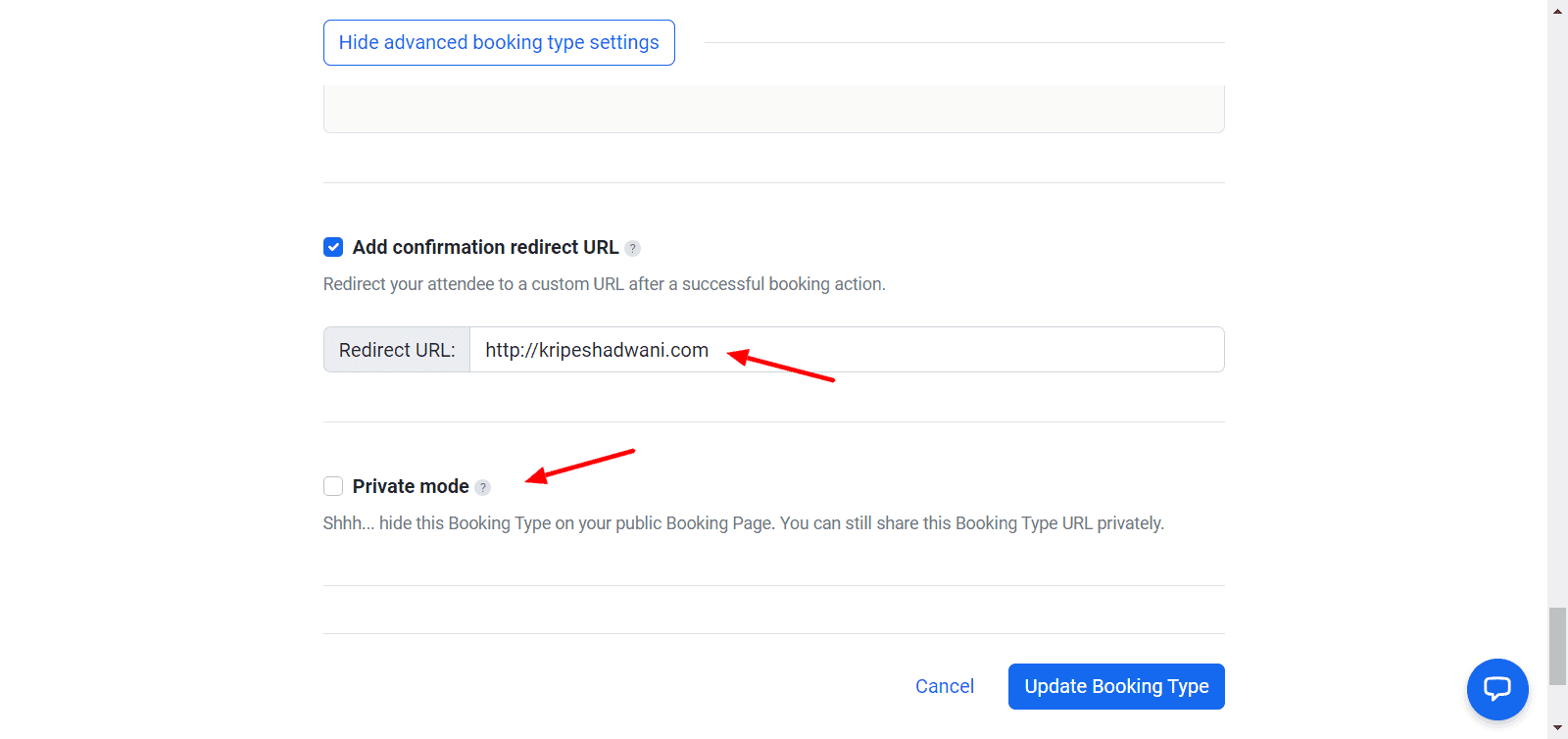
Step 3: Configure a custom redirect URL in your calendar platform
Now configure your booking platform to redirect users to your confirmation page after they complete a booking.
For Cal.com users
Log in to your Cal.com account
Go to your event type settings
Open Advanced settings
Turn on Redirect to a custom URL after a successful booking
Enter your confirmation page URL
Make sure Forward parameters is enabled (this is on by default). This appends booking data like email, name, and phone to your redirect URL.
Save your changes
Cal.com will redirect users to your confirmation page with booking details appended as URL parameters, which PixelFlow can extract.
Cal.com parameters: Cal.com appends parameters like email, attendeeName, attendeeFirstName, attendeeLastName, phone, and title to your redirect URL when Forward parameters is enabled.
For TidyCal users
Log in to your TidyCal account
Navigate to your event settings
Find the Redirect URL or Custom Confirmation URL setting
Enter your confirmation page URL
Save your settings
Detailed instructions: How to redirect clients to a custom URL after booking (TidyCal)
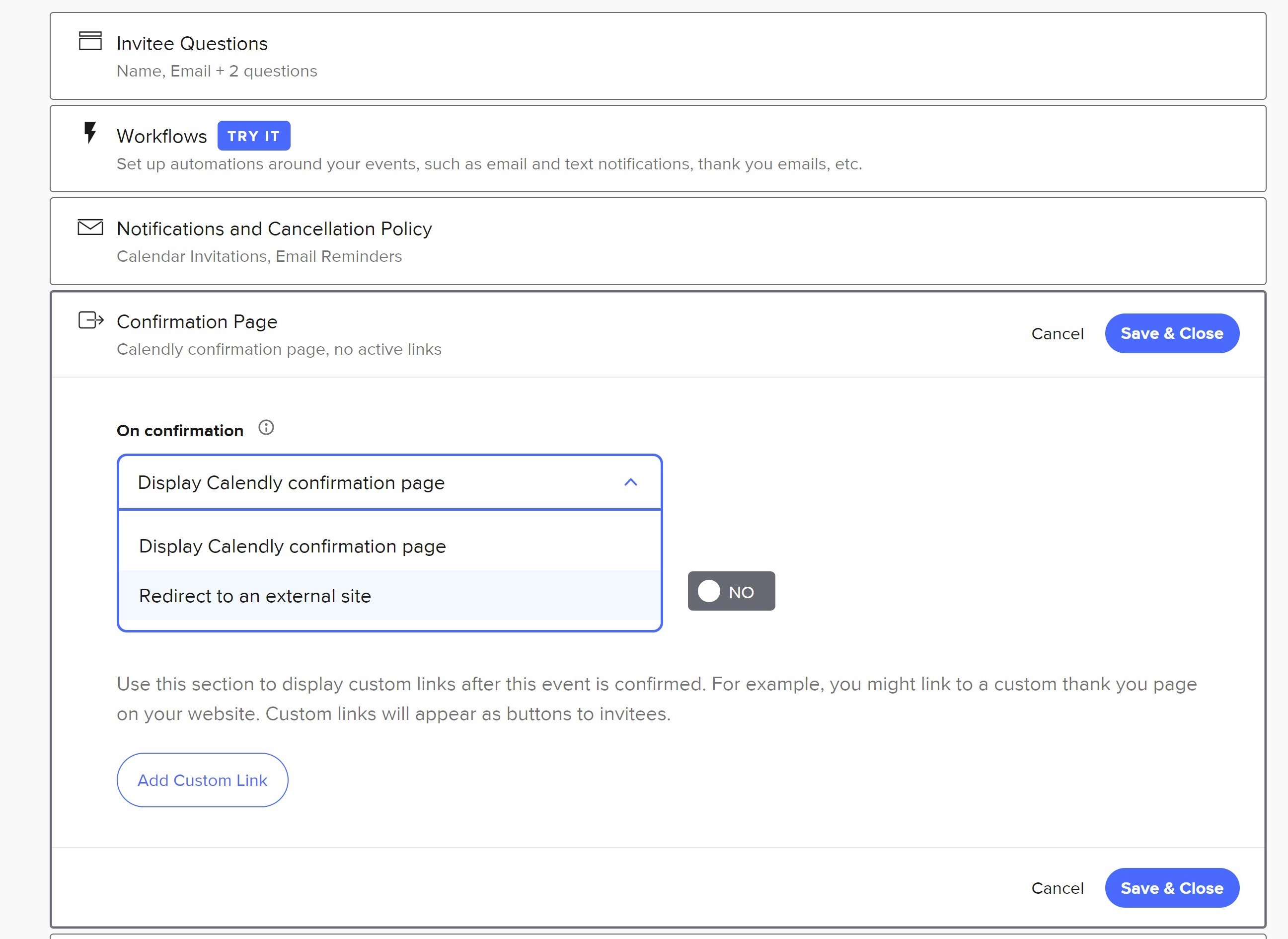
For Calendly users
Log in to your Calendly account
Go to your event type settings
Navigate to the Confirmation Page section
Select Redirect to an external site
Enter your confirmation page URL
Select Pass event details to your redirected page if you want booking details included for tracking or personalization
Save your changes
Pro tip: Calendly can append booking data to your redirect URL as query parameters. You can capture this data and send it to Meta to improve event match quality.
For Typeform users
Typeform allows you to pass respondent data through redirect URLs using URL parameters. This is useful if you're using Typeform for lead capture, surveys, or intake forms before or instead of calendar bookings.
Log in to your Typeform account
Open your form and click Workflow
Click Pull data in to set up URL parameters that can capture data passed into the form
Click + Add new parameter and name your parameters (e.g.,
utm_source,utm_campaign)Go to Content and click + Add ending
Select Redirect to URL
Enter your confirmation page URL (e.g.,
https://yourwebsite.com/form-completed)To pass respondent answers to the redirect URL, type
?followed by the parameter name and=, then type@to see available fieldsSelect the field you want to pass (e.g., email, name, phone from Contact Info questions)
Example redirect URL:
https://yourwebsite.com/form-completed?email=@email&name=@name&phone=@phoneSave your changes
When someone completes your Typeform, they'll be redirected to your confirmation page with their answers appended as URL parameters. PixelFlow can then extract these values and send them to Meta.
Important: Typeform URL parameters must use lowercase letters and underscores instead of spaces (e.g., first_name, not First Name). Values will be URL-encoded in the redirect.
Passing data into Typeform: You can also pass data into Typeform via URL parameters in the share link (e.g., https://yourform.typeform.com/to/abc123#utm_source=facebook&utm_campaign=summer_sale). This data can then be forwarded to your redirect URL.
Step 4: Set up a URL Trigger in PixelFlow
Configure PixelFlow to fire an event when users land on your confirmation page:
In your PixelFlow dashboard, click Track more events from Overview, Events, or Get Started.
On Add a new Facebook Ads conversion, select the event you want (typically Schedule), then click Next.
On How is this event being triggered on your website?, choose When a page loads. For Schedule, PixelFlow may rank When Calendly call is booked first if you use the Calendly integration instead.
On Which page should trigger this event?, paste your confirmation page URL under Page URL.
Click Create trigger, or Next if the URL includes query parameters to map.
Whenever a user completes a booking and lands on your confirmation page, PixelFlow fires the event to Meta. For the full page-load walkthrough, see How to Trigger Events When a Page is Loaded.
Extract data from URL parameters
Many calendar platforms like Calendly and Cal.com append booking details to your redirect URL as query parameters. For example:
Calendly example:
yourwebsite.com/[email protected]&invitee_name=John+Doe&event_type=Discovery+CallCal.com example:
yourwebsite.com/booking-confirmed?uid=abc123&[email protected]&attendeeName=John+Doe&attendeeFirstName=John&attendeeLastName=Doe&phone=%2B15551234567PixelFlow can extract these parameters and send them to Meta, which improves event match quality and attribution.
When setting up the page-load trigger, paste a full example confirmation URL that includes the query parameters.
When PixelFlow detects parameters, click Next to open Confirm what's in your URL.
Map each parameter to the right Facebook field.
Click Create trigger.
Why this matters: Sending email, name, and phone data to Meta improves Event Match Quality, which helps Meta attribute conversions and optimize delivery. This data is hashed before sending.
Common Calendly parameters:
invitee_email→ Email addressinvitee_name→ Full nameinvitee_first_name→ First nameinvitee_last_name→ Last nameinvitee_phone→ Phone number
Common Cal.com parameters:
email→ Email addressattendeeName→ Full nameattendeeFirstName→ First nameattendeeLastName→ Last namephone→ Phone number
Some Cal.com parameters are conditional and will not appear in every redirect. For example, phone and attendeeLastName only appear if the booking form collected that information.
For detailed platform-specific setup, see Extract Data from URLs When Using URL Triggers.
Typeform parameter mapping: The parameter names in your redirect URL depend on how you configured them. Common examples include email, name, phone, and custom fields. Map these to Meta fields: email → Email address, name → Full name, first_name → First name, last_name → Last name, phone → Phone number.
Step 5: Prevent duplicate events with blocking rules
After someone books a call, they might return to your confirmation page later, refresh the page, or share the link. Each of these actions would trigger another event, inflating your conversion numbers.
To prevent this, set up Event Blocking Rules:
In your PixelFlow dashboard, navigate to Event Blocking Rules
Create a rule for your confirmation page URL
Configure it to block duplicate events from the same user within a specific timeframe
This ensures that even if someone revisits your confirmation page, only the first visit counts as a conversion.
Learn more: Event Blocking Rules
Best practice: Always implement Event Blocking Rules for confirmation pages to maintain accurate conversion data and prevent Meta from receiving false signals.
Verify your setup
After configuring your calendar booking tracking, test it to ensure events are firing correctly:
Go to your website and navigate to the page with your calendar embed
Book a test appointment
Complete the booking process
Verify you're redirected to your confirmation page on your domain
Check your PixelFlow dashboard Events Log to confirm the Schedule event was captured
Within 20 to 30 minutes, verify the event appears in Meta Events Manager
Testing tip: Use your PixelFlow Events Log first. It updates in real time. Meta Events Manager can take 20 to 30 minutes.
For comprehensive testing guidance, see How to Test and Verify Your PixelFlow CAPI Setup.
Troubleshooting common issues
Events not firing after booking
Symptom: You complete a booking but no event appears in your Events Log or Meta Events Manager.
Redirecting to external domain: Verify your confirmation URL is on your own domain.
URL Trigger not configured: Check that you've added the confirmation page URL in PixelFlow.
Wrong URL format: Verify the URL in PixelFlow matches the final URL users land on.
Events firing multiple times
Symptom: Single bookings generate multiple events in Meta Events Manager.
Page refreshes: Users refreshing the confirmation page can trigger new events. Use Event Blocking Rules.
Bookmarked confirmation page: Use Event Blocking Rules to prevent duplicates.
Multiple redirects: Check the final landing URL and use that in your URL Trigger configuration.
Learn more about preventing duplicates: Why are Some of my Events Duplicated?
Redirect goes to an external platform instead of my domain
Symptom: After booking, users land on the calendar platform's confirmation page, not your custom page.
Setting not saved: Verify the custom redirect URL is saved correctly.
Plan limitation: Confirm your calendar platform plan supports custom redirects.
Event-specific setting: Some platforms require redirect URLs for each event type.
Events tracked but attribution missing in Meta
Symptom: Events appear in Events Manager but aren't attributed to specific ad campaigns.
Solution: This is usually a Meta attribution issue, not a PixelFlow configuration problem. Review How Meta Attributes Events to Ad Campaigns.
Alternative: Embedded calendars with thank-you messages
Important limitation: If your calendar tool shows a confirmation message within the widget itself without changing the page URL, URL Trigger tracking will not work. The URL does not change, so PixelFlow cannot detect that a booking occurred.
Comparison: Different calendar tracking scenarios
Scenario | Can track with PixelFlow? | Method |
|---|---|---|
Redirect to your own domain | ✅ Yes | URL Trigger tracking |
Redirect to external platform | ❌ No | Cannot track |
Confirmation within widget | ❌ No | Cannot track |
Custom calendar on your domain | ✅ Yes | URL Trigger or class-based tracking |
Best practices for calendar booking tracking
Best practice checklist:
Always configure custom redirects to a page on your own domain
Use a unique, specific URL for your confirmation page
Implement Event Blocking Rules to prevent duplicate events from page refreshes
Test your complete booking flow before launching ad campaigns
Monitor your Events Log regularly to ensure bookings are being tracked
Choose calendar platforms that support custom redirect URLs if tracking is essential
Enable booking data forwarding (Pass event details / Forward parameters) to capture email, name, and phone for better attribution
What's next
Once you've set up calendar booking tracking, you can:
Learn about How to Track Events for Form Submissions to capture lead information before calls
Explore How to Track & Trigger Events for other types of conversions on your website
Understand How to Trigger Events When a Page is Loaded for additional use cases
Review Event Blocking Rules to maintain clean, accurate conversion data
Getting help
If you're experiencing issues with calendar booking tracking or need help configuring your setup:
Check your PixelFlow dashboard Events Log to see if events are being captured
Verify your calendar platform supports custom redirect URLs and that you've configured them correctly
Book a free setup call with our team to get personalized help configuring your calendar tracking
Contact support with your booking URL, confirmation page URL, screenshots of your settings, and any error messages
Need help? Our team offers free setup calls to ensure your calendar booking tracking is configured correctly.